The Whymper Couloir
An Alpine classic for a long weekend
Date: 30 April 2025
Team: David Cattell (UK), Jacek Wichłacz (PL), Radek Sołtykowski (PL),
Gear:
- Two 60 m ropes
- Two ice axes, crampons
- Two ice screws
- Rappel device
- Two long slings
Written by: Jacek Wichłacz
This summit had been a long-standing goal for us. The route is legendary—one that can only be tackled in just the right conditions, and with a long, committing approach. Over the years, we’d made several attempts via different lines, but always came up short. The weather didn’t play ball, or rockfall in the couloir forced us to turn back.
About 15 years ago, we met Zbigniew Młynarczyk—an icon of historic Himalayan expeditions—at the bergschrund below the face. He was attempting this “green needle” for the fourth time, again without success. He told us plainly: to climb this peak, you need the right conditions. If you’re going up the couloir, the snow has to be hard-frozen from night through to the next day. You need sharp route-finding, and you need to move fast—up and down.
This time, we waited patiently for the perfect forecast: a week of stable, clear skies, just enough to catch the tail end of the alpine winter and squeeze in one more shot at the Whymper Couloir.
So, on the evening of Saturday, 26 April 2025, Radek and I packed our gear and skis and drove to Chamonix. On Sunday afternoon, we met up with David Cattell from Llanberis, North Wales ho we’d climbed with before. On Monday (28 April), the three of us set off.
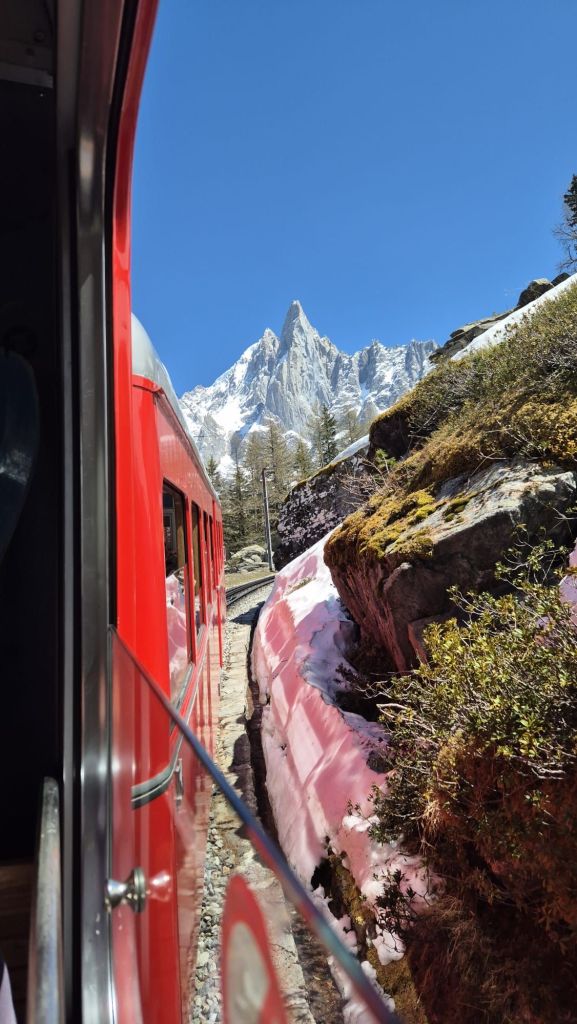
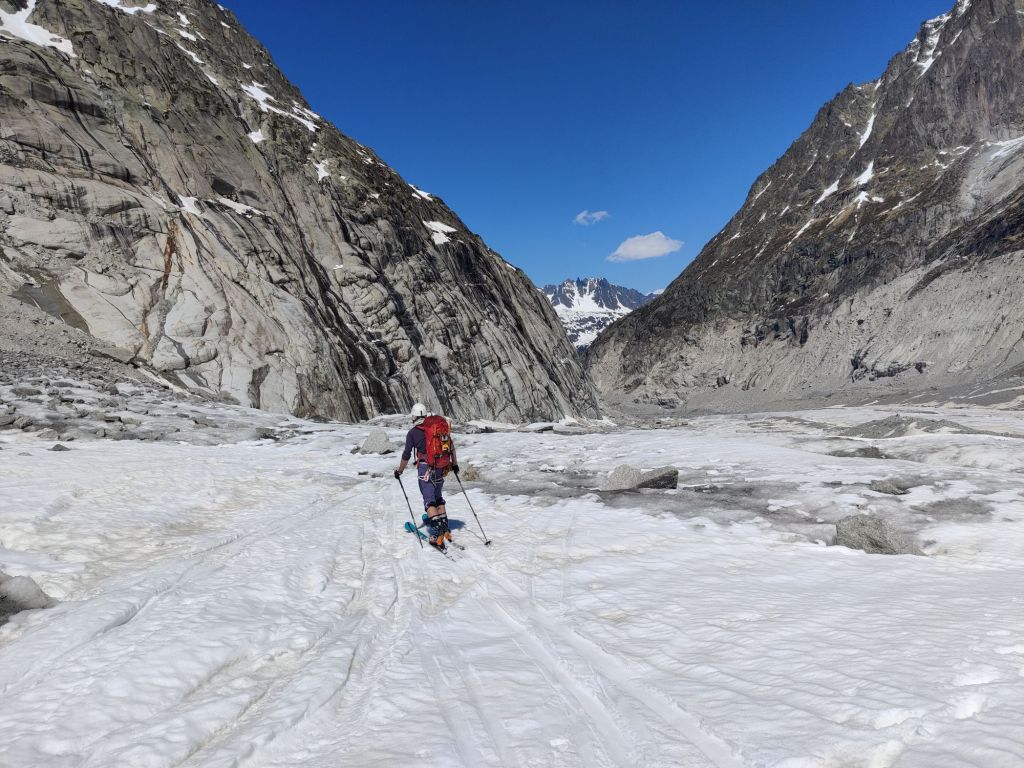
We took the famous Montenvers train, then descended on the new gondola to the Mer de Glace. The glacier was already more rubble than snow, so we had to walk the first two kilometers with skis strapped to our packs. Eventually, we hit skiable snow and made progress on skis toward the wide gully on the Glacier de Talèfre, heading for the Couvercle Hut.
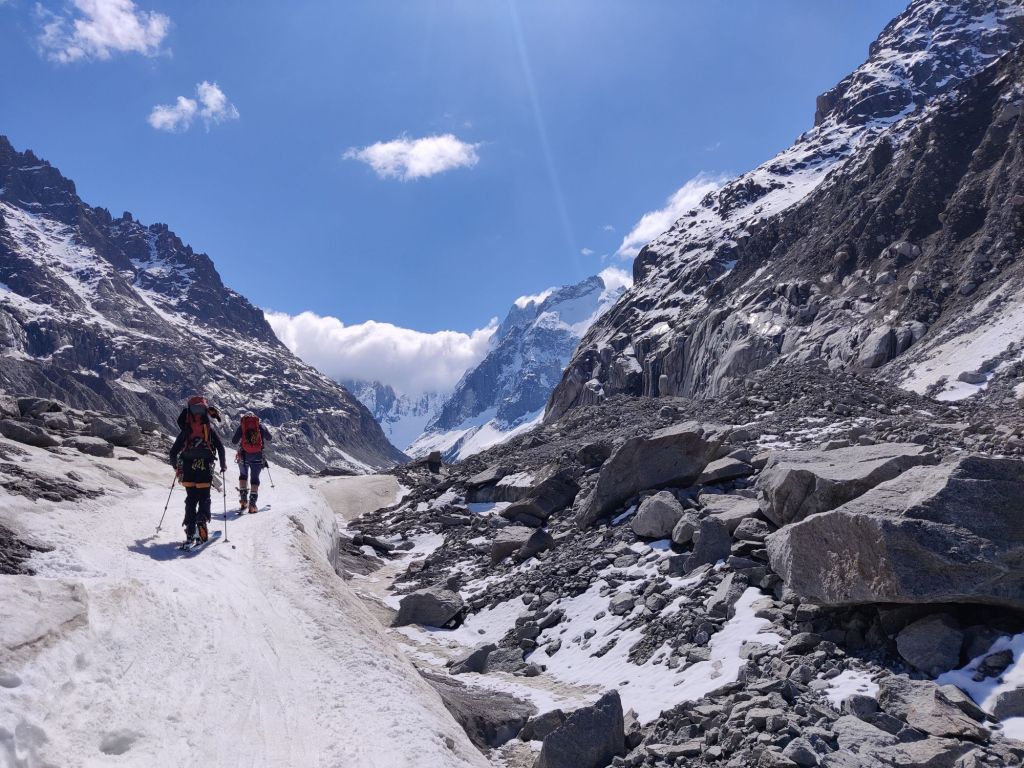
But the snow ran out again near the final slope, so we once more shouldered our skis. A short scramble over the rocky step by the waterfall and we could finally click back in. From there, the climb to the Couvercle Hut (2,698 m) was uneventful.
That night, we had dinner with a lively international crowd, most of whom were planning climbs the next day. For us, Tuesday was a rest day—no rush.

Midnight Start
The weather was still on our side, but we were a little concerned: daytime temperatures at the hut were now above freezing. Fortunately, other skiers descending from the couloir said nighttime temps were still well below zero, and conditions were good.
We made a plan: midnight wake-up, early breakfast, and be the first team on the move.
After a generous dinner (Couvercle has good food—and second helpings!), we tried to sleep. None of us managed. So at midnight sharp, we sat down for breakfast. No one really felt like eating, but we forced down some food and drink—probably not our smartest move.
At 00:15 on Wednesday, 30 April, we set off. The snow was icy, and we skinned up with ski crampons, as our skins had little grip on the steep, hard sections. It was a moonless night—total darkness except for the small cone of light from our headlamps.
On one of the more exposed sections of the glacier, Radek pulled up beside Dave.
“My heart rate’s at 198,” he said. “My stomach’s a mess. I think I’ve got to turn back.”
We encouraged him to keep going, telling him things would likely settle. But Radek was clear:
“I’m heading back.”
And with that, he disappeared into the blackness below.
By then, several teams had passed us. Dave and I carried on behind them. About an hour later, we reached the base of the couloir. Quick changeover—skis off, crampons on, axes out—and we tackled the bergschrund. We crossed at the lowest point (around 3 meters high), where the snow and ice were solid. A couple of swings, and we were over.
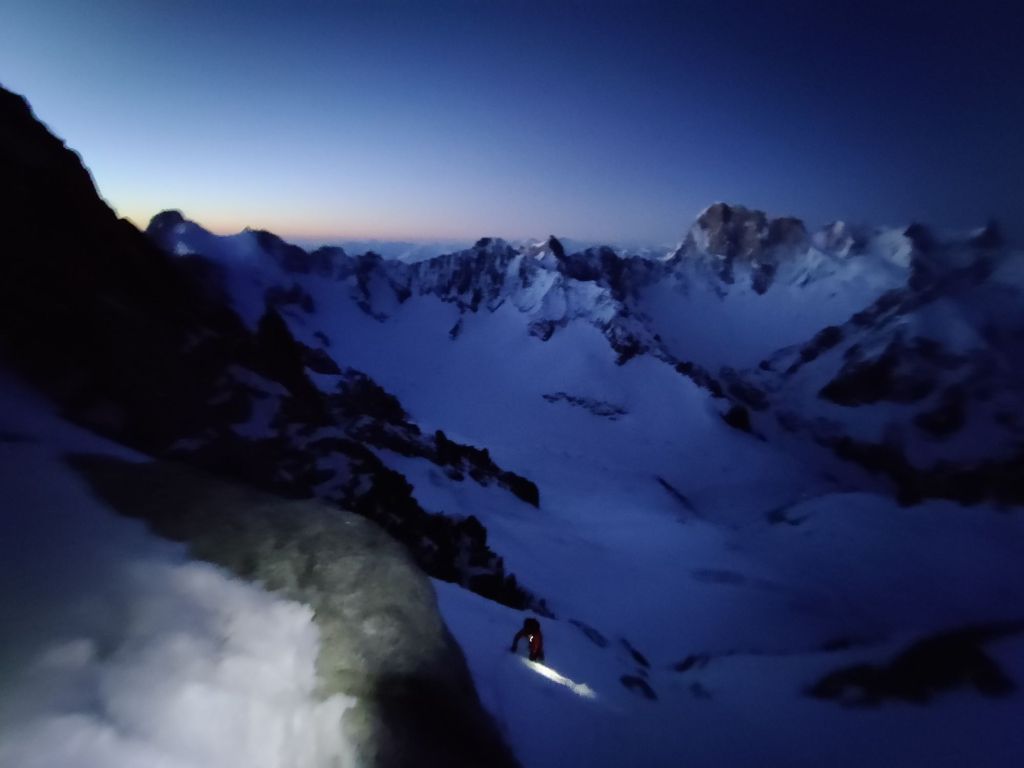
Now the climb began in earnest: a long, monotonous ascent up a 45–55° couloir. Unfortunately, being behind other teams meant we had chunks of ice raining down from above. It was too dark to see anything coming. One sharp piece hit me hard in the shoulder—thankfully, my backpack strap absorbed some of the blow. It could have been worse.
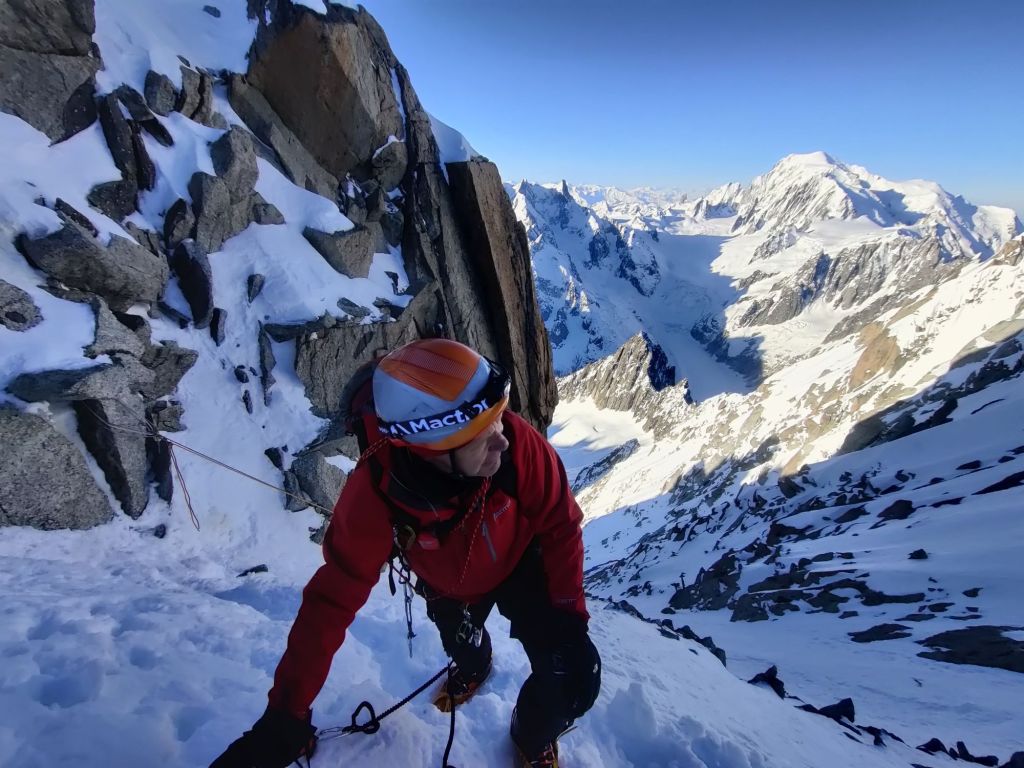
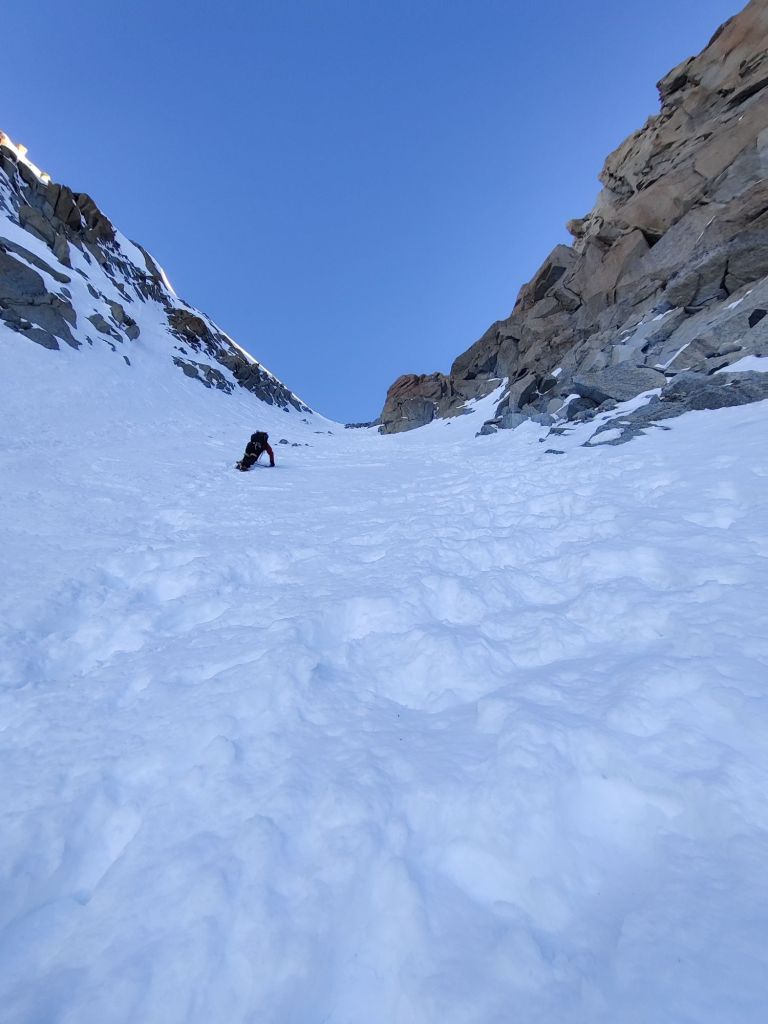
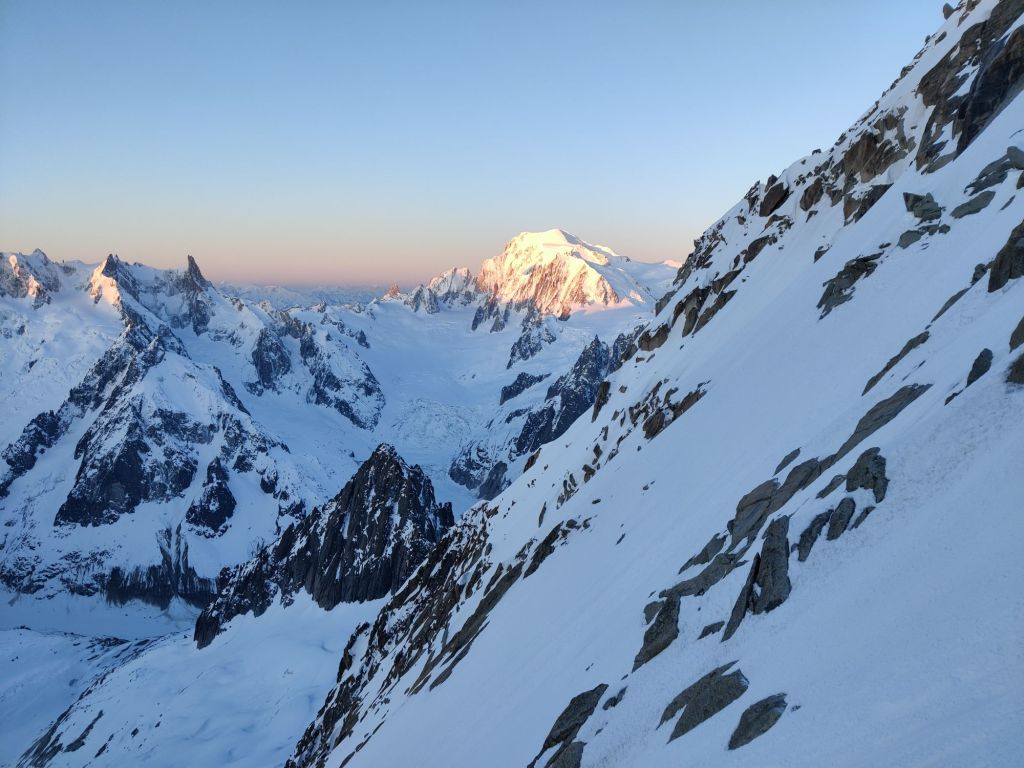
Soon we reached an exposed traverse into the main, broader couloir leading up to the col. We crossed it quickly and safely. The wide couloir hid its end from view, so the climbing felt endless and draining. But daylight was beginning to hit the peaks around us. The view that opened up was breathtaking: Mont Blanc, the towering north face of the Grandes Jorasses, and the Rochefort ridge with its famous Grand Dent.
Summit and Descent
Eventually, the col appeared in golden sunlight. That gave me a second wind—though not quite enough to take flight. I pushed through the final meters and reached it more quickly than expected.
There, we roped up—the ridge to the summit was narrow and snow-covered. The top looked close, but it was still at least another half hour away.
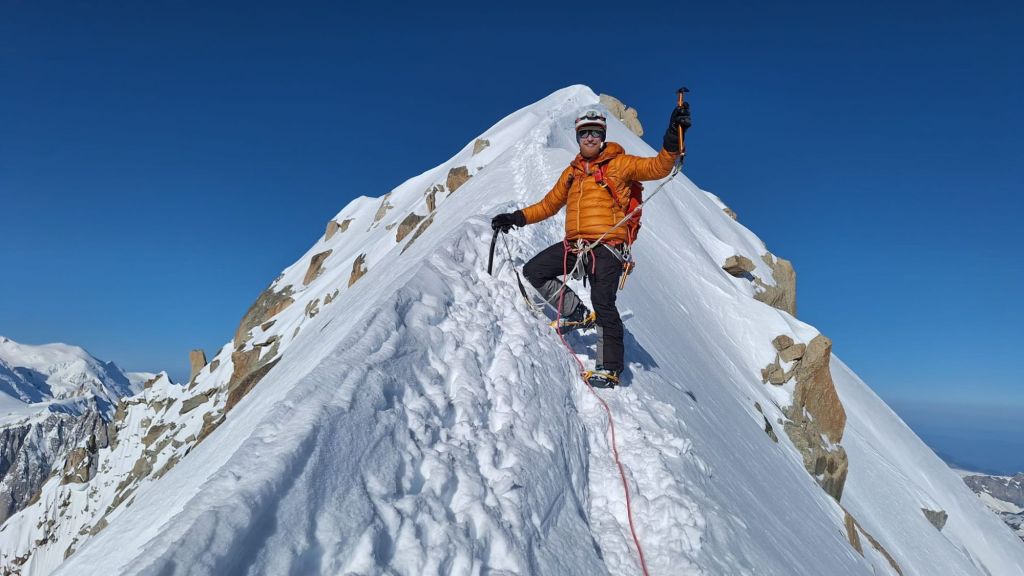
And then, finally—the summit.
Surprisingly, no summit cross.
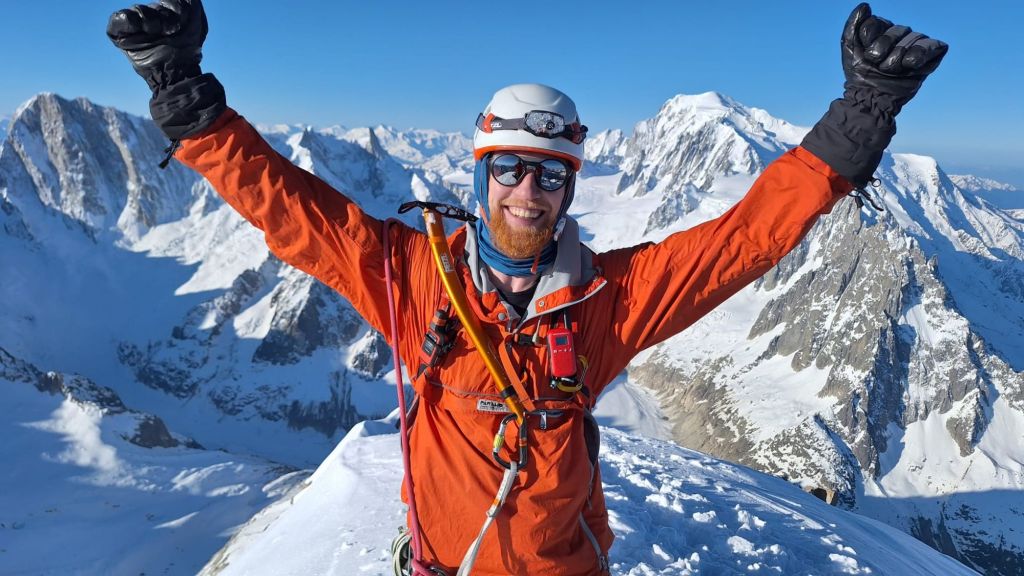
It was 9:00 a.m. Dave and I stood alone, surrounded by the highest peaks in the Alps, under flawless blue skies. A light frost, a soft breeze, and an ocean of mountains around us. Tiny houses and winding roads in Chamonix lay 3,000 meters below. You could stare at that view forever.
Aiguille Verte was my 54th Alpine 4,000er—and it finally “let me in” on my fourth attempt. The view more than made up for all the earlier struggles.
The Couloir Comes Alive
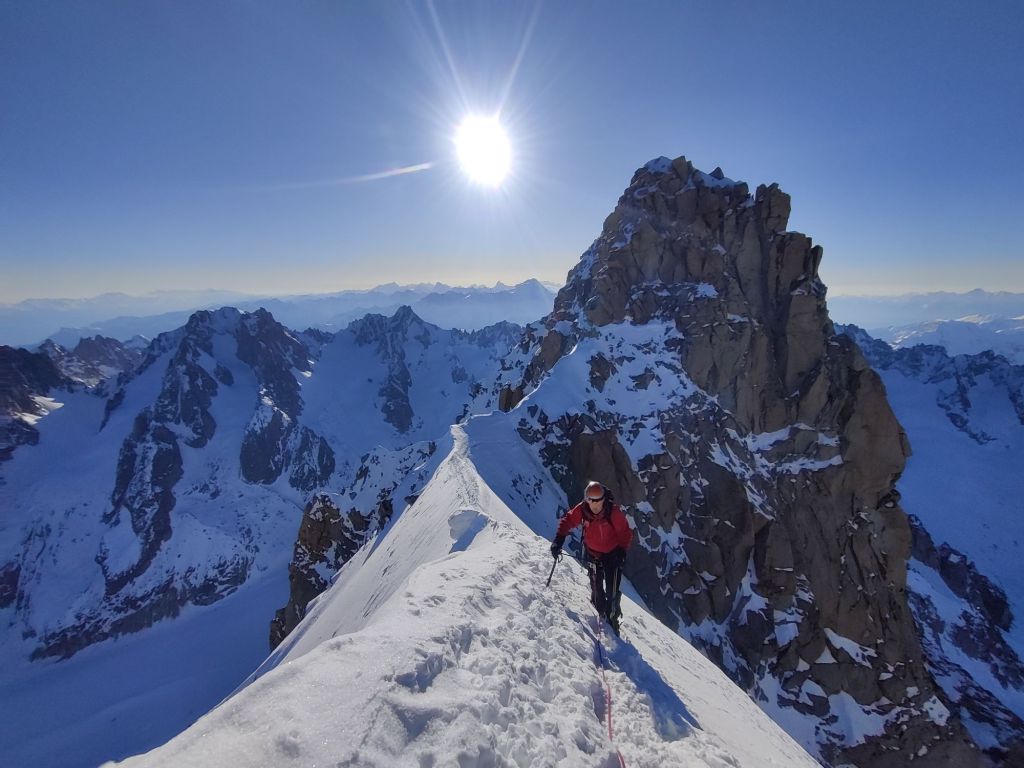
From the summit, we returned to the col and began the descent. We had two 60-meter ropes, and rappel anchors are spaced at 60 meters—though we found a few closer ones too, which helped speed things up in the now-slushy snow.
Our two small radios were invaluable. With that much distance between us, even shouting wouldn’t have worked.
By then, the sun had reached the couloir and it was getting hot. We reached the final rappel over the bergschrund. Dave went first and disappeared. But the rope stayed tight. What was going on down there?
Finally, the radio crackled:
“Jacek, stop. The glacier below is full of soft, sagging crevasses. It’s dangerous. You need to rappel from a different spot.”
Easier said than done—our anchor was at the rock. But Dave, with the better view, guided me to the middle of the couloir, the same spot where we’d originally crossed on the way up. I traversed 20 meters across, then rappelled diagonally down to the skis.
Just in time. Ten minutes later, a “river” of wet, loose snow came flooding down the exact line we’d just avoided. The couloir had come alive. Small rockfalls and slides were now pouring down from all sides.
The ski back to the hut wasn’t much fun—alternating wet snow, hard ice in the shade, then slush again. Finally, we made it to the hut, where Radek was waiting—rested and in good shape. This time, health and common sense had prevailed. :-(
Back to Chamonix
The next day (01 May) wasn’t any easier. We had to descend the gully onto the glacier and ski all the way to the Montenvers gondola. Yet again, the day was warm and sunny—not exactly ideal conditions for glacier travel.
But by early afternoon, we were back in Chamonix. Hot showers, well-earned pizza, a cold beer… and, of course, all with a perfect view of Mont Blanc.
 Sump To Summit
Leave a comment